Early Notification Scheme: families and carers frequently asked questions
Welcome to our Early Notification (EN) Scheme’s FAQ page for families and carers. We appreciate that this is a difficult time for you and your family, and we hope to answer some of your questions below.
If there is anything you are not sure of, or would like to know more about, please visit our EN introduction page which has information and contact details for the EN team and our EN Family Liaison and Mediation Lead.
We are responsible for managing clinical negligence claims brought against the NHS. Our role includes sharing learning to help improve patient safety and to preserve resources for patient care.
Clinical (or medical) negligence is when medical professionals or organisations, who owe a legal duty of care, do not meet the expected standard of care, causing injury to a patient or the patient’s condition becoming worse.
A three-part legal test needs to be carried out. You can find more information about this by watching the ‘Introduction to clinical negligence claims’ short video below.
NHS Trusts have to tell us about maternity incidents which meet a certain criteria. Under the EN Scheme, a team of clinicians and lawyers work together to investigate circumstances where babies have sustained specific brain injuries at birth to find out if the harm has been caused by clinical negligence. The team completes an early investigation into the care and provides compensation if their three-part legal test shows there has been clinical negligence. They also help NHS trusts take steps to learn from these incidents and work together to improve maternity and neonatal care (care in the first four weeks of a baby’s life). Please read the ‘How do you decide whether my baby is eligible for compensation?’ section below for more information about the legal test.
Babies who meet the criteria to be reported to us by NHS Trusts include full-term babies (at least 37 completed weeks of pregnancy) born following labour who have had a potential severe hypoxic brain injury confirmed on an MRI scan. This means that babies who are born by elective caesarean section, and babies who have sadly died within the first week of life (between birth and six days) will not be eligible for review under the EN Scheme.
A potential severe brain injury is diagnosed in the first seven days of a baby’s life. To diagnose this, one or more of the following must apply.
The baby must have been diagnosed with moderate to severe hypoxic ischaemic encephalopathy (HIE). This is a brain injury caused by the baby’s brain not getting enough oxygen.
The baby must have been therapeutically cooled (active cooling only). This is where their body temperature is lowered using a cooling mattress or cap, with the aim of reducing the impact of HIE.
The baby must have had an altered state of consciousness, with seizures, weak muscle tone, abnormal reflexes or abnormal suck.
(The above is a simplified version of the Maternity and Newborn Safety Investigations (MNSI) criteria.)
The EN Scheme investigates a specific type of brain injury which meets our clinical MRI criteria.
We investigate cases involving therapeutically cooled babies where there is evidence of ongoing neurological injury (damage to the brain, spinal cord or nerves). This would usually mean that, to meet our investigation criteria, there will be a brain MRI scan showing evidence of intrapartum (during labour) hypoxic ischaemic encephalopathy (HIE). Intrapartum HIE is a type of brain injury that happens when the supply of oxygen to the brain is disrupted. We will assess cases reported to us to confirm if there is evidence of hypoxic injury on the MRI scan. Our clinical team will carry out an initial review, which will consider whether there are any initial concerns about the care you and your baby had and whether that care may have caused injury to your baby. If there are concerns that the care may have caused injury to your baby, we will carry out a full legal investigation. If your baby was born on or after 1 October 2023, we will ask for your permission to do this and ask you to sign a form giving us permission to access additional medical records.
The EN Scheme carries out an investigation to see if there was any clinical negligence.
The MNSI programme completes safety investigations which focus on systems and processes in healthcare, identifying the factors that could have led, or could lead, to harm for patients. It does not look at investigations from a legal perspective.
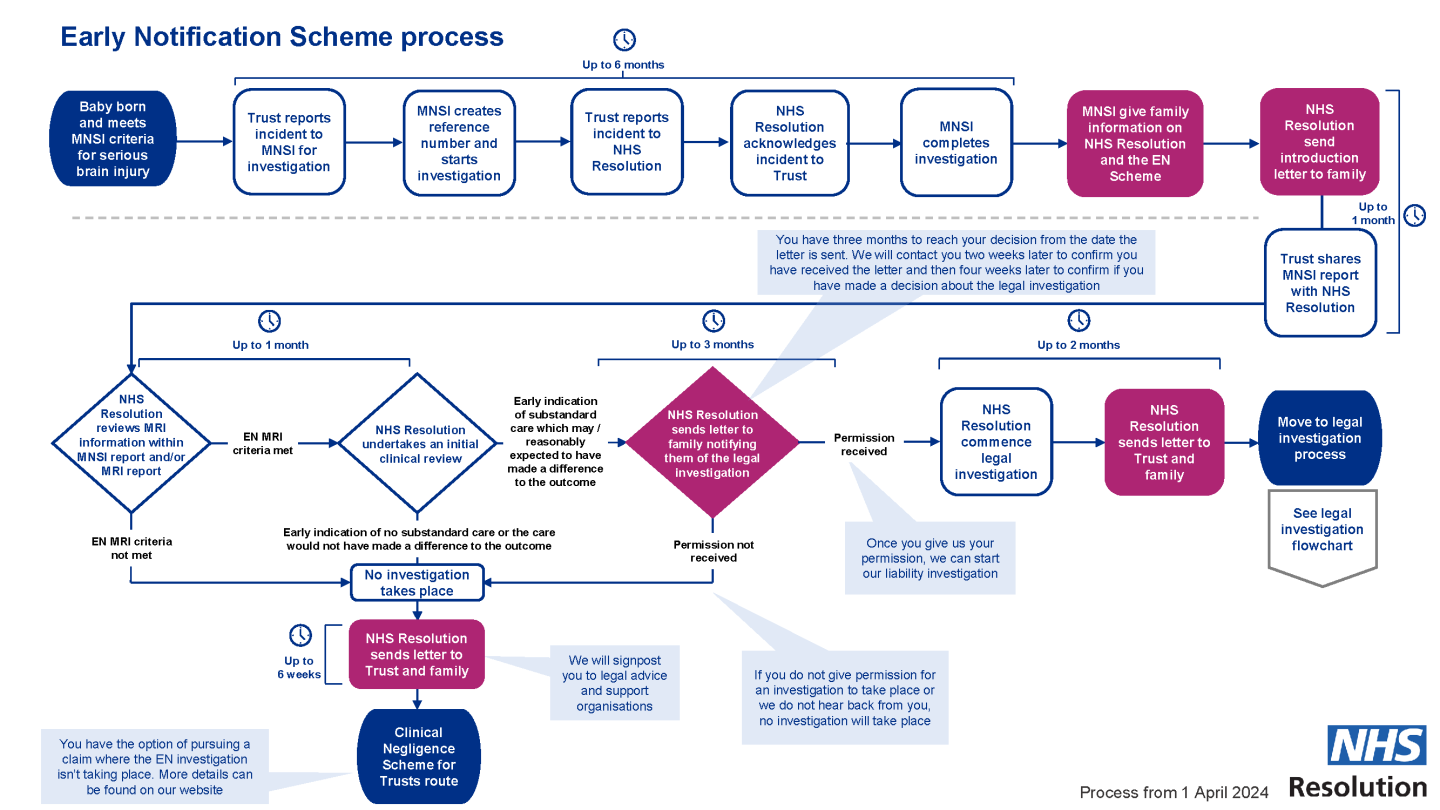
The flowchart below shows the steps of the investigation process for the EN Scheme investigation process.
Click to see flowchart
If the harm was caused as a result of something a clinician did, or failed to do, while using their clinical judgement, clinical negligence law will determine whether you are entitled to compensation.
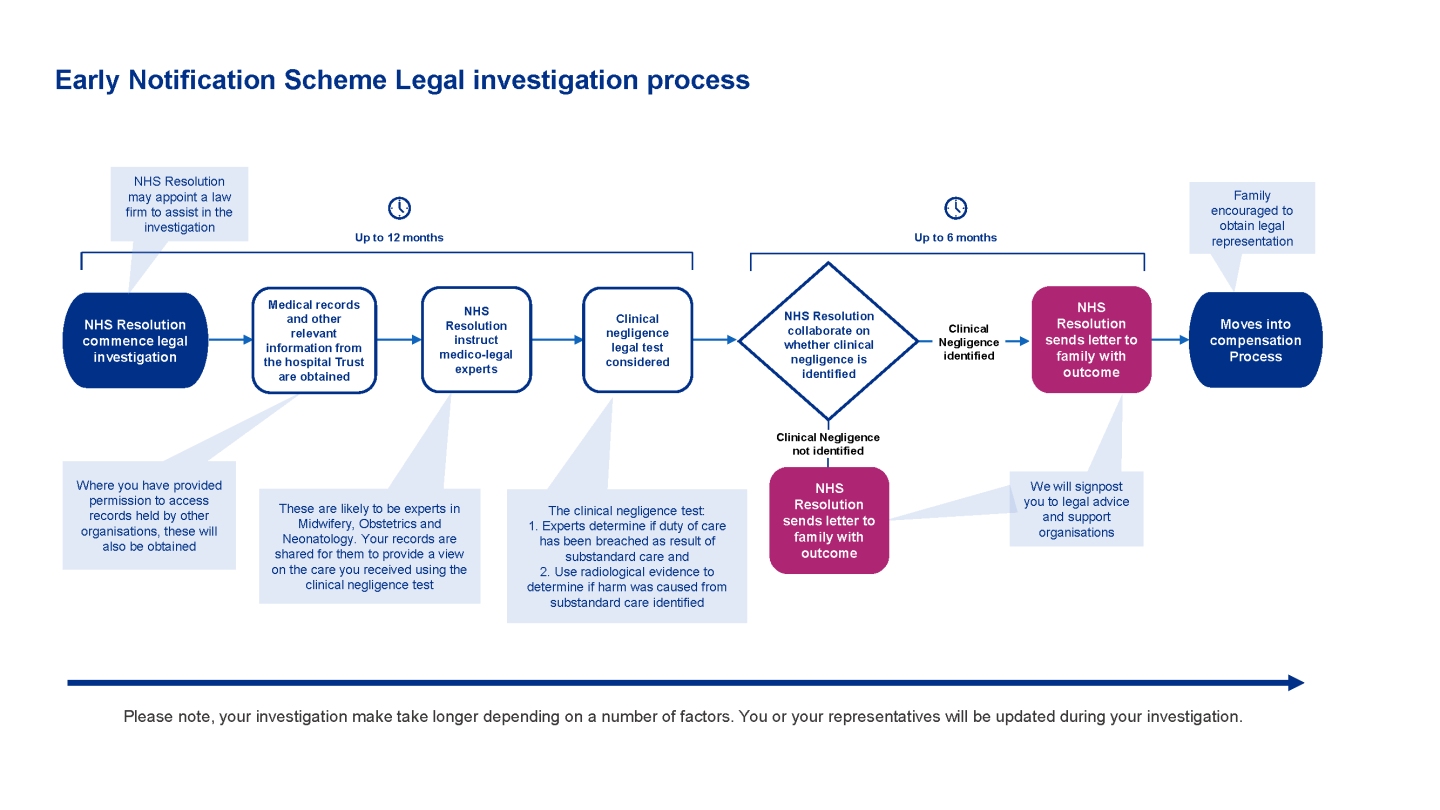
The flowchart below shows the steps of the legal investigation process.
Click to open flowchart
Summary of the legal investigation process
The hospital trust will report a baby’s birth which meets the scheme criteria to us. We will agree with you how often and in what way you would like us to contact you. If you instruct your own lawyers at any point, we will then communicate with them, rather than with you.
Step 1: Once the hospital trust has received the report from the Maternity and Newborn Safety Investigations (MNSI) programme, they will share it with us. This is usually six months after your baby’s birth. We will check the details of your baby’s MRI scan (which takes up to one month), and if there is evidence your baby has an intrapartum hypoxic brain injury we will move to step 2.
Step 2: We will carry out an initial review of your and your baby’s care and write to you with the outcome. If there are concerns that your care may have caused injury to your baby, we will carry out a full legal investigation. If your baby was born on or after 1 October 2023, we will ask for your permission to do this and ask you to sign a form giving us permission to access additional medical records (unless you have instructed lawyers by this point, in which case we will communicate with them). This step takes up to three months.
Step 3: Once we have received your permission, we will contact you and explain the next steps.
Step 4: Once we have received all the medical records from the various providers, we will share these with independent medical and legal experts who give their view on your care, using a legal test to assess whether you are entitled to compensation. The types of experts will vary, but often include a midwife, an obstetrician, a neonatologist and a neuroradiologist.
Step 5: We will consider the experts’ opinions and may meet them to discuss your care. This is to decide whether the care caused or contributed to your baby’s injury, and whether you will receive compensation.
Step 6: We will write to you or your lawyer with the outcome of the investigation. This detailed letter will explain whether your care was appropriate and whether or not there has been clinical negligence. You can then share the letter with any lawyer you instruct. This step takes about 18 months. (It may take longer than 18 months to receive this letter if we need to carry out further investigations.)
Documents produced when giving or receiving legal advice are protected under a principle called legal privilege. This means we will not be able to give you copies of the experts’ reports or other documents created during the investigation. Legal privilege also applies if you instruct your own lawyers.
You can get independent legal advice at any time. Or, you may want to wait until you have received our letter with the outcome of our investigation before considering whether to contact a specialist clinical negligence lawyer about making a claim.
The types of experts we instruct will vary, but often include a midwife, an obstetrician (a doctor specialising in pregnancy and labour), a neonatologist (a doctor specialising in looking after infants who are unwell after their birth) and a neuroradiologist (a doctor specialising in the interpretation of brain scans). In some cases a paediatric neurologist (a doctor specialising in diagnosing and managing neurological disorders in children) may also be instructed.
An expert’s duty is to the court. Their purpose is to provide a neutral opinion which is independent from us or the hospital trust. They advise on the standard of the care provided and whether, if that care had been different, your baby would have been less unwell following their birth. They will use the legal tests to help us and the trust establish whether there was clinical negligence.
The experts will consider the medical records and any other relevant documents, including incident investigation reports, local and national guidance and policies in place at the time of your care, and comments from staff who treated you and your baby. .
An expert’s duty is to the Court and their purpose is to provide neutral opinions which are independent from the Hospital Trust or NHS Resolution. They advise on the standard of the care provided and whether, if the care provided had been different, the baby would have been less unwell following birth.
The medical experts will need to review your medical records from your pregnancy, labour and birth. They will also need to see your child’s medical records (from birth onwards).
We have access to records held by the hospital trust where your child was born. The experts may also need to review records held by other healthcare providers, such as neonatal records from a different hospital trust if your child was transferred to a specialist unit after birth, their GP’s notes and other hospital notes, and those from other services (such as physiotherapy and occupational therapy). We will need your consent to access the records held by organisations other than the trust where you gave birth. If you have not already done so, please sign and return the consent form we sent you (the form of authority).
We will handle your records, and any information that arises from our investigation, sensitively and securely. When we need to share any information from the investigation, we will make that information anonymous before we share it. To find out more about how we will use this information, please see our privacy notice.
The following three-part legal test must be met for your child to be entitled to compensation as a result of clinical negligence. To see this information as a video or animation, please select here.
Duty of care. Medical professionals have a duty of care (a legal obligation to ensure the safety and well-being of others). In most circumstances, a duty of care applies even if the medical professional is not your lead physician, and can apply to any clinical role, such as a doctor, nurse, midwife, nurse assistant, allied health professional or paramedic.
Breach of duty. The duty of care must have been breached, meaning that the treatment received must have fallen below the standard considered to be proper by a reasonable and responsible group of clinicians (for example, midwives, nurses, doctors and so on) in the same situation.
Causation. Once a breach of duty has been identified, it must be shown that it was likely that this caused harm or injury to you or your baby. There has to be a direct link between the care that fell below the required standard and any harm caused for the legal test to be met.
If breach of duty and causation are proven, the court will award financial compensation (otherwise known as damages).
The charity Action Against Medical Accidents provides useful explanations and self-help guides which provide further detailed information.
At the end of our investigation, we will send you a detailed letter with a summary of our findings and the reasons for them, including whether your baby is entitled to compensation.
We will not be able to give you copies of the experts’ reports or other documents created during the investigation. This is because documents produced when giving or receiving legal advice are protected under a principle called legal privilege. Legal privilege also applies if you instruct your own lawyers.
You can ask the hospital trust for copies of your medical records at any time, and you should also have received a copy of the safety investigation report from the MNSI.
If our investigation finds that the care fell below the expected standard, has caused an injury and there has been clinical negligence, your child will be entitled to compensation. We strongly advise you to get independent legal advice from a solicitor who specialises in these types of clinical negligence claims.
The next stage will be to carry out further investigations to decide how much compensation you will be paid. It can be difficult to assess the financial support your child will need, as they are still developing and the extent of their disability may not be known as their needs are changing.
It may take several years to agree a final settlement. In the meantime, the courts may award an interim payment to cover the costs of items or care your child needs immediately or in the near future. We will invite you and your representative to a meeting shortly after you have received the outcome letter. This meeting can be in person or online, depending on the circumstances. The aim of the meeting will be for us to better understand your child’s current condition and whether they have any needs which are currently not being met, and to get further information which can help us make interim payments.
We recommend that the lawyer accompanying you to this meeting is the lawyer acting for you and your baby, as they will be able to guide you through these discussions. If you have not yet appointed a solicitor, we can delay the meeting until you have found someone who you want to represent you.
There are strict legal rules about the time you have to make a claim for a child or parent, so we encourage you to get independent legal advice about this as soon as possible.
Helpful guides
The patient safety charity, Action Against Medical Accidents (AvMA), have published guidance to help with calculating the time limit for making a claim. You can access this by scanning the AvMA QR code below or by typing the website address below into your web browser. https://www.avma.org.uk/wp-content/uploads/Legal-time-limits.pdf
You can phone our EN team and its dedicated Family Liaison and Mediation Team on 0207 811 6263 (Monday to Friday 9am to 5pm) or email them at nhsr.enteam@nhs.net Where can I go for advice and support?