
To mark International Day of the Midwife, we are delighted to celebrate and hear from some of our talented midwives who work in our Safety and Learning team.
Please tell us about yourself
Hello, I am Leann Morris and I am proud to say I am a midwife. I live in the beautiful, sometimes sunny, Devon with my husband, three sons and two dogs.
Tell us about your role at NHS Resolution
I work as the Senior Programme Manager within the Safety and Learning Team. I am currently leading the evaluations of NHS Resolution’s two landmark maternity schemes, the Early Notification Scheme and the Maternity Incentive Scheme. These two schemes are major within the maternity landscape and have real benefits to the maternity system for staff and patients. Ensuring these schemes are comprehensively evaluated for their impact and experiences of our stakeholders, whilst making recommendations for improvement, is pivotal to ensure we are keeping abreast of the ever changing and demanding maternity environment, with the safety of birthing families at the heart of it.
I have also been leading on the Recommendation to Implementation workstream within Emergency Medicine. There is an abundance of recommendations to improve patient safety, and the Recommendation to Implementation workstream focuses on examining recommendations and establishing a robust framework for tracking prioritisation and implementation. Through this workstream I have been able to work collaboratively with key external stakeholders, such as the Royal College of Emergency Medicine, and a range of colleagues within NHS trusts who have been involved in a proof of concept exercise.
Describe your midwifery background
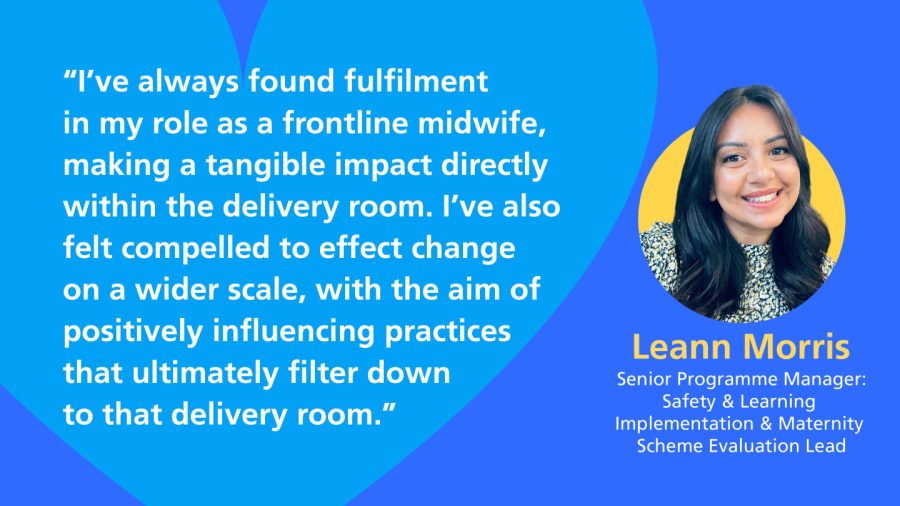
I qualified as a midwife in September 2011 whilst 37 weeks pregnant with my second son! My clinical experience spans across three South West trusts, encompassing both the community and hospitals. I have had the privilege of attending births in a variety of settings. Throughout my career I have developed a robust foundation in governance, patient safety, and practice development through various positions, including my recent role as the Perinatal Quality and Surveillance Midwife within my local ICB. I’ve always found fulfilment in my role as a frontline midwife, making a tangible impact directly within the delivery room. However, I’ve also felt compelled to effect change on a wider scale, with the aim of positively influencing practices that would ultimately filter back down to that delivery room. Leading on the evaluations allows me to contribute to making the maternity system safer for all. Currently, I am pursuing a master’s degree in Patient Safety and Human Factors, aligning with my passion for enhancing systems to improve patient care and outcomes.
What inspired you to become a midwife?
At the age of 18 I became a mum, and I had the most incredible care during my pregnancy and labour from some remarkable midwives who left an indelible mark on me. Their dedication and compassion inspired me deeply. After researching the role, I knew it was the career for me – being able to be a part of a monumental occasion in a family’s life is a true privilege. So, at 20, I decided to take the leap and left the banking world and pursued this career. I have never looked back.
Why is it so important to have colleagues working with a clinical background at NHS Resolution?
Having a clinical background and experience provides direct insight into the challenges that healthcare professionals face while working on the frontline and delivering patient care. The multi-professional approach within our organisation ensures that we genuinely collaborate and leverage our diverse professional experiences to enhance the healthcare system. Involving clinical colleagues in claims ensures rigorous credibility in the resolution process and helps extract learning from patient safety events, that we can relay back to the system and make improvements to our own processes.
Why do you think your midwifery experience brings value to your role at NHS Resolution?
My background in midwifery gives me a practical and empathetic approach leading on these workstreams. Often there is a view of work as imagined vs work as done, and drawing on my time as a labour ward coordinator within a busy maternity unit (which was one of my favourite jobs by the way), keeps me focused in pursuing practical and meaningful improvements within our healthcare system.
Page last updated on: